The Dopamine Dilemma: Why Modern Education Needs a Gamification Upgrade

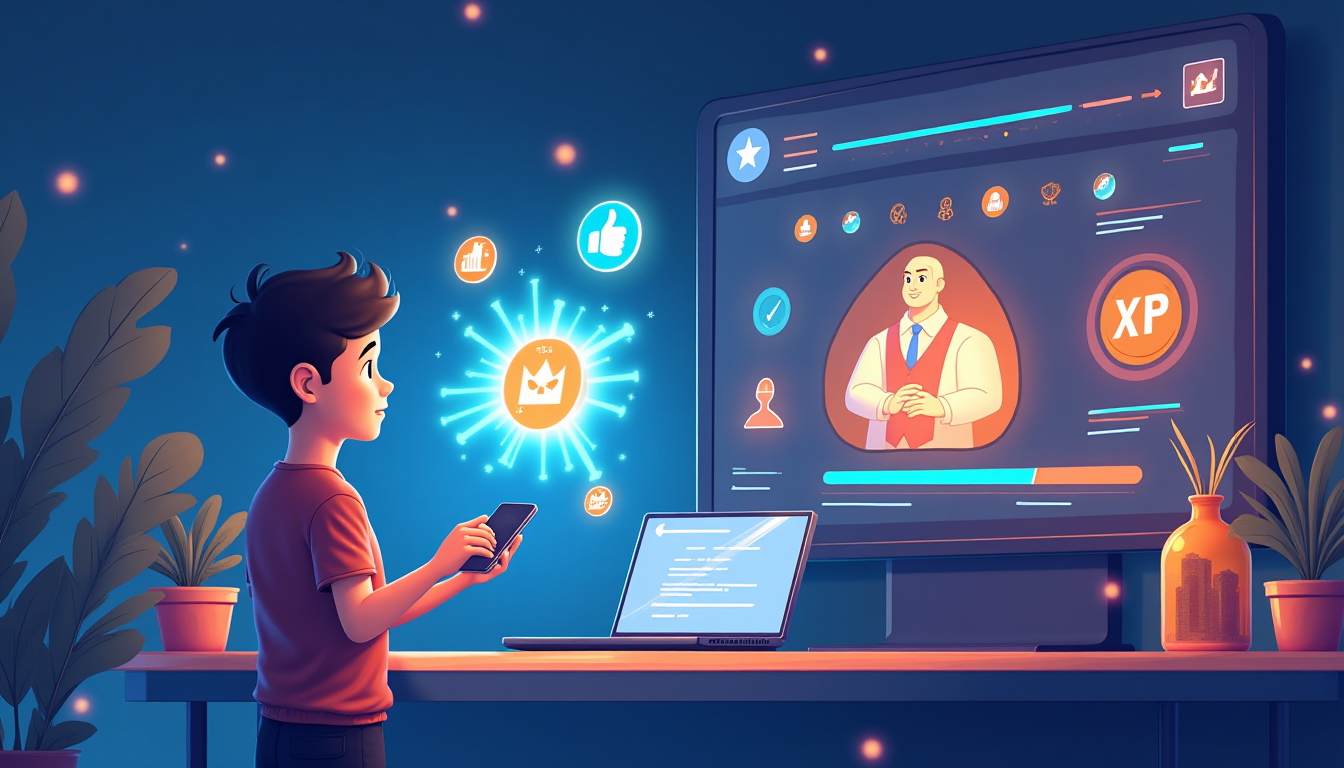
We’ve all seen it: a student sitting with a textbook, eyes glazing over after five minutes, fighting a losing battle against boredom. Yet, place that exact same student in front of a video game, and they will lock in for hours—hyper-focused, problem-solving, and strategizing.
The standard cultural consensus is quick to dismiss this: "This generation just has a low attention span."
But cognitive science tells a different story. Today’s students don't lack the capacity to focus; they are growing up in a hyper-optimized digital ecosystem where the competition for their attention has fundamentally changed. If education is to survive in the era of short-form media, it must stop fighting the psychology of modern engagement and start leveraging it.
The solution does not lie in lowering our standards, but in changing our architecture. By weaving proven cognitive science techniques into a structural gamification framework, we can design learning environments that outcompete the scroll.
The Clash of Brain Chemistry: Reels vs. Textbooks
To understand why traditional learning feels like an uphill battle, we have to look at how human brains process rewards.
For centuries, formal education has operated on a model of delayed gratification. You study hard today, pass an exam next month, and graduate in a few years to build a career. It is a long, slow, invisible arc.
Enter TikTok, Instagram Reels, and YouTube Shorts. These platforms are masterfully engineered loops of instant gratification. Every swipe delivers a micro-dose of dopamine—the neurotransmitter associated with anticipation and reward—in under 15 seconds.
When a brain conditioned for instant feedback is forced to sit through a passive, hour-long lecture or read a static text without any immediate sign of progress, it experiences stimulation withdrawal. The brain checks out, not out of laziness, but out of a deep neurological craving for feedback.
We cannot eliminate short-form media. Instead, we have to fix the feedback loop of learning.
Moving Beyond "Points and Badges"
True educational gamification is not about slapping a leaderboard onto a standard quiz. That is superficial "content gamification," and it rarely leads to deep understanding.
True gamification applies game mechanics to the cognitive process itself. It uses the structural architecture that makes games addictive—clear goals, instant feedback, and a narrative role—to drive heavy mental lifting. When we map game mechanics directly onto established cognitive learning techniques, we transform passive consumers into active thinkers.
The Architectural Blueprint: Science Meets Mechanics
Here is how we can integrate core cognitive science principles directly into a gamified structure to create permanent, deep understanding.
1. Active Recall as "The Gatekeeper Quest"
The Science: Active recall requires the brain to actively fish for information from its memory banks rather than just passively re-reading a textbook. Forcing the brain to exert effort to retrieve a memory alters and strengthens the underlying neural pathways, making the knowledge durable.
The Gamification: Structure learning as a journey punctuated by Gatekeeper Quests. To unlock a new territory, level, or advanced resource, the student must "defeat" a Gatekeeper. This isn't a multiple-choice question; it's a prompt that requires them to explain a concept in their own words or solve a puzzle using what they just learned. The natural desire for progression drives the student to willingly engage in high-effort retrieval.
2. Spaced Repetition as "Shield Degradation & Daily Bounties"
The Science: The Ebbinghaus Forgetting Curve demonstrates that humans lose memory exponentially unless it is reviewed at calculated intervals. Reviewing information right when it is about to be forgotten resets the curve and cements information in long-term memory.
The Gamification: Games excel at getting players to return daily through routines. Once a student masters a concept, that skill badge glows gold on their dashboard. Over time, driven by a forgetting-curve algorithm, the badge starts to "tarnish." To polish the shield or restore the skill to 100%, the student must successfully complete a quick retrieval blast. Framing review as upkeep or a "Daily Bounty" transforms maintenance from a chore into a tactical choice.
3. Elaborative Interrogation as "The Detective Mode"
The Science: Elaborative interrogation involves explicitly asking why and how facts work, forcing the brain to form deep connections and integrate new information into the student's existing mental schema.
The Gamification: Frame the student as an investigator. Trigger a "Detective Mode" mini-game when a new concept is introduced. The system challenges them: "Your opponent claims this ecosystem will survive, but why? Choose the underlying mechanism to break their argument." Instead of memorizing a rule, the student actively interrogates the cause-and-effect relationship to level up their toolkit.
The Rules of Engagement
| Cognitive Science Technique | Core Educational Objective | Game Mechanic Equivalent | Psychological Driver |
| Active Recall | Stronger neural pathways via effortful retrieval. | Boss Battles / Gatekeeper Quests | Accomplishment & Progress |
| Spaced Repetition | Interrupt the forgetting curve at optimal intervals. | Shield Degradation & Daily Bounties | Ownership & Scarcity |
| Elaborative Interrogation | Form deep connections by asking "Why?" | Detective Mode / World-Building | Meaning & Intellectual Curiosity |
| Retrieval Practice | Low-stakes testing to build memory retention. | Infinite Response (Zero-Penalty Retries) | Empowerment & Growth Mindset |
Changing the Fear of Failure
Perhaps the greatest intersection of game design and cognitive science lies in how we handle mistakes. In traditional education, mistakes are permanent failures that ruin a grade—a high-stakes environment that breeds anxiety. In game design, mistakes are just data points. If your character falls into a pit, you learn where the pit is, hit "respawn," and try again with better data.
By employing infinite respawns—allowing students to retry retrieval challenges without permanent grade penalties—we reduce the fear of failure. This fosters a true growth mindset, keeping students in a state of optimal challenge, often referred to by psychologists as "flow."
The Ultimate Takeaway
Gamification provides the emotional fuel (engagement, curiosity, progression), while cognitive science provides the structural engine (retention, comprehension, mental models).
We are not going to win a war against the immediate rewards of short-form digital media by using outdated, passive delivery systems. To educate a generation raised on instant feedback, our learning frameworks must become just as dynamic, responsive, and rewarding as the world around them. When designed with scientific intent, we don't just capture a student's fleeting attention—we unlock their genuine, lifelong joy for learning.